
How Long Should Your College Audition Be? Prescreen & Live Timing Rules
You’ve found your song. You’ve polished your monologue. You’ve rehearsed until the words feel like your own. But as your college audition date approaches, one question keeps surfacing: How long should this actually be?
It’s a question that trips up more students than almost any other part of the process — and the stakes are real. Show up with a two-minute song when the panel expected 32 bars, and you risk looking unprepared before you’ve sung a single note. Submit a prescreen video that runs too long, and it may not get watched at all.
Timing in college auditions isn’t just a logistical detail. It’s a signal. It tells the faculty watching you whether you understand the industry you’re trying to enter, whether you can follow directions, and whether you respect the process they’ve built. At College Audition Project, we work with students every day who are navigating exactly these questions — and the answers are more specific than most guides let on.
Here’s what you actually need to know.
Why Audition Length Is a Skill in Itself
Before getting into the numbers, it’s worth understanding why timing matters so much at the college level.
BFA and BA programs at competitive conservatories and universities are built around an incredibly structured audition season. Faculty panels may see 400 to 800 students across a single recruitment cycle. Each of those students has been given guidelines — for song length, monologue duration, prescreen format — and the faculty expect those guidelines to be followed.
When you go over time, you’re not just taking an extra 30 seconds. You’re signaling that you didn’t read the instructions carefully, that you prioritize your own comfort over the process, or — worst case — that you don’t yet know the professional norms of this world. None of those impressions serve you.
When you nail the timing, you demonstrate something equally important: you can make strong choices under constraint. That’s a skill you’ll use every day as a working performer.
How Long Should a College Audition Song Be?
This is where most students start, and it’s also where the most confusion lives. The short answer: it depends on what you’ve been asked for, and most programs will tell you exactly what they want. The longer answer requires understanding the vocabulary.
The 16-Bar Cut
A 16-bar cut is the audition world’s equivalent of a first impression — compressed, intentional, and entirely focused on your best 30 to 45 seconds. This doesn’t literally mean counting 16 measures from the top of a song. It means selecting a passage of music, usually centered on the climax or the most emotionally resonant moment, that fits within that window.
For open calls, large unified auditions like Unifieds, and programs that see extremely high applicant volume, 16-bar cuts are standard. You’re not there to tell a whole story. You’re there to make a faculty member want to know more.
The most common mistake with 16-bar cuts is choosing the wrong section. Students often start at the beginning of a song out of habit. Instead, find the moment where the song is most you — where your voice is strongest, where the emotional truth is clearest — and cut to that.
The 32-Bar Cut
A 32-bar cut runs approximately 60 to 90 seconds and is the most common audition format at the college level. It gives you enough room to establish a character, build through a journey, and land an ending. Most BFA musical theatre programs, whether you’re auditioning in person or at a regional audition festival, will expect something in this range unless their materials specify otherwise.
Sixty to ninety seconds is the industry standard audition song length for most college programs, and for good reason: it’s enough to evaluate voice, technique, emotional range, and instinct without eating into the next student’s time.
Full Song Auditions
Some programs — particularly at later rounds, callbacks, or for graduate-level admissions — may ask for a full song or multiple songs. In these cases, follow their guidance precisely. If they say “two contrasting songs totaling no more than four minutes,” that four-minute ceiling is not a suggestion.
The Golden Rule for Song Length
Never exceed the time you’ve been given, and never assume more is better. A 45-second cut performed with total commitment will outperform a 90-second cut that meanders. Faculty are not grading on duration. They’re grading on impact.
How Long Should a Monologue Be for a College Audition?
For acting and musical theatre programs, the monologue is often where students struggle most with pacing — both in terms of actual time and in terms of performance rhythm.
The Standard: 60 to 90 Seconds
Most college musical theatre audition requirements specify a monologue of roughly one to two minutes. In practice, the strongest monologues tend to land between 60 and 90 seconds. This is long enough to establish a relationship, build through an arc, and resolve — the three things every good monologue needs to accomplish.
A monologue shorter than 45 seconds rarely gives faculty enough to evaluate. You hit a beat or two and it’s over. A monologue longer than two minutes — unless specifically requested — starts to feel like you’re not making choices. Editing is a craft. Knowing what to cut is as important as knowing what to keep.
When Programs Ask for Two Contrasting Monologues
Many BFA programs, especially those with strong acting components, will ask for two contrasting pieces — often one classical and one contemporary, or one dramatic and one comedic. In these cases, the total time for both pieces combined is usually capped at three to four minutes. That means each monologue should average around 90 seconds to two minutes, with clean transitions between them.
Practice the transition. The moment between two pieces — how you reset, how you shift into the second piece without a full stop — is itself a moment of performance.
The 30-Second Question
Students frequently ask whether 30 seconds is simply too short for any monologue. The honest answer: yes, in most contexts. A 30-second monologue might work as a commercial read or a very specific callback request, but as a self-selected piece for a BFA program, it communicates that you either haven’t prepared enough material or haven’t found a piece you can sustain. Find something you can fill — emotionally, physically, intellectually — for at least a minute.
Prescreen Video Length: What Programs Actually Watch
Prescreen submissions have become a standard first step in the college audition process, and they’ve changed the game in ways many students don’t fully appreciate. Your prescreen video is your first audition — and in many cases, it determines whether you get an in-person audition slot at all.
Typical Prescreen Format
Most programs ask for a prescreen video of two to four minutes in total length. This usually includes one song (16 to 32 bars), one or two monologues, and sometimes a dance or movement component depending on the program.
Some programs provide very specific time limits — “no more than 90 seconds of singing” or “one monologue, maximum 90 seconds.” Others give broader guidance. Either way, your prescreen video should never run longer than what was requested, and it should be as tight as possible within that window.
Why Prescreen Length Matters Even More Than Live Audition Length
In a live audition room, there’s a human dynamic. A faculty member might let an exceptional student run a few seconds over because the energy in the room earns it. A prescreen video doesn’t have that relationship. If it exceeds the limit or feels padded, it gets forwarded through or switched off. Faculty reviewing hundreds of prescreens in a single sitting have no patience for unnecessary length.
Keep it clean. Slate clearly (name, hometown, school, pieces you’ll be performing). Then perform. No elaborate setups, no apologies, no re-takes spliced together. Straight through.
One Camera Angle, Good Light, Clear Audio
Timing is part of prescreen quality, but the production basics matter just as much. A well-lit, well-framed, one-take video that runs exactly 90 seconds communicates professionalism. A choppy, over-edited three-minute video does not — regardless of the talent in it.
How to Prepare for a College Audition: Building a Timed Run
Understanding timing is one thing. Executing it under pressure is another. Here’s how to build timing into your preparation:
Record yourself every time you run material. Not just occasionally — every time. Watching your recordings teaches you where you’re rushing, where you’re lingering, and where cuts need to be made or adjusted. It also builds comfort with performing to a camera, which matters enormously for prescreens.
Practice the full package, not just individual pieces. If your audition includes a song and two monologues, run the entire sequence in order from the slate to the final line. The transitions between pieces are performance too, and they’re often where students lose time without realizing it.
Time yourself without an accompanist and with one. Live piano changes everything about how a song moves. Your 32-bar cut may run 75 seconds with your practice track and 90 seconds with a pianist who takes the opening phrase slightly slower. Know both numbers.
Build in time for the unexpected. Faculty may stop you mid-song and redirect you. They may ask you to do the monologue again with a specific adjustment. They may ask you questions about your material or yourself. Your prepared pieces should be performable in a significantly shorter window than the maximum time limit — so that if you’re cut off at 45 seconds, you’ve still shown them something complete and compelling.
Program-Specific Timing: Always Read the Requirements
Everything in this guide reflects general best practices across the college musical theatre audition landscape. But programs vary — sometimes significantly — in what they ask for, and their specific requirements always take precedence.
A program that asks for a 16-bar cut wants a 16-bar cut, not 32 bars because you feel more comfortable with the longer version. A program that caps prescreens at two minutes means two minutes, not two minutes and forty seconds because you couldn’t find a clean place to cut.
Part of learning how to prepare for a college audition is treating each program’s requirements as a separate assignment. Build a spreadsheet. List every school’s requirements side by side. Note the time limits, the format preferences, the specific genre requests. Then prepare material that works within the most restrictive requirements while still showcasing everything you need to show.
When programs are flexible — “prepare one to two songs” or “bring one or two contrasting monologues” — default to tighter rather than longer. A tight, confident 60-second monologue almost always outperforms a meandering 90-second one from the same actor.
Quick Reference: College Audition Timing at a Glance
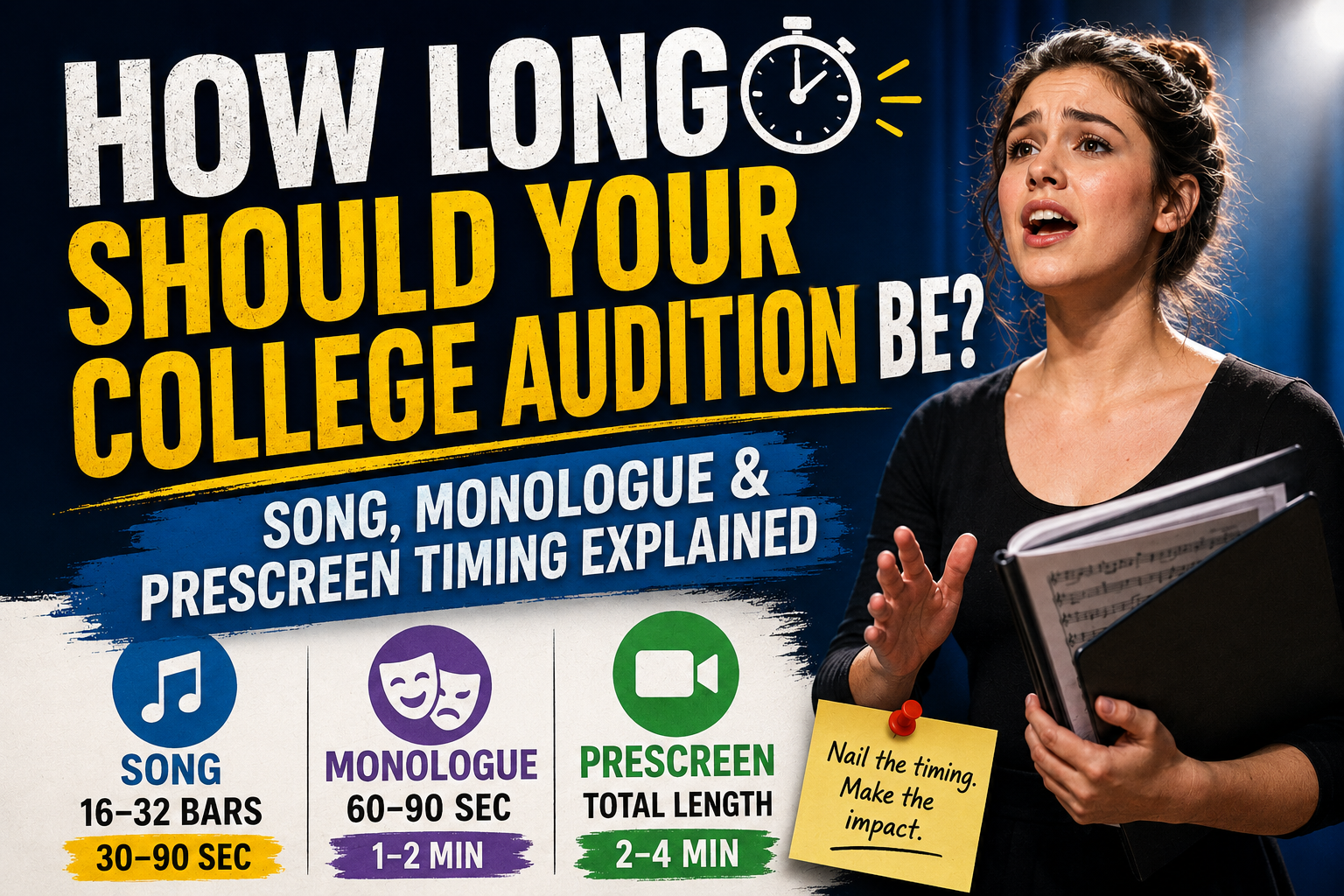
16-Bar Song Cut: 30–45 seconds — used for open calls, unified auditions, high-volume programs
32-Bar Song Cut: 60–90 seconds — most common college audition format
Single Monologue: 60–90 seconds — standard for most BFA and BA programs
Two Contrasting Monologues: 90 seconds each / 3–4 minutes combined
Prescreen Video (Total): 2–4 minutes — follow each school’s specific limit exactly
Full Audition (Song + Monologue): 3–5 minutes — varies by program; always defer to requirements
Final Thoughts: Timing Reflects Preparation
The students who consistently advance through college audition processes aren’t always the most technically gifted in the room. They’re the most prepared. And preparation includes knowing — in your bones, not just on paper — exactly how long every piece of your audition runs, why it runs that long, and how to adjust if the situation calls for it.
Timing is not a constraint on your performance. It’s a frame that makes your performance legible. Work within it, and you show faculty that you’re ready to work within the structures of a professional program. That readiness is exactly what they’re looking for.
At College Audition Project, we help students build that kind of comprehensive preparation — from material selection and audition technique to the logistical realities of navigating a full college audition season. If you’re ready to go into your auditions with that level of clarity and confidence, we’re here to help you get there.
Get Expert Feedback on Your Audition Package! Explore CAP Membership